Solution topic
Honey High-Viscosity Filling: Combining Temperature Holding, Anti-Stringing, and Bottle Mouth Sealing
Configure servo piston filling, heated hopper, screw capping, or heat sealing equipment according to honey fluidity, filling temperature, bottle/pail containers, and lid film struc
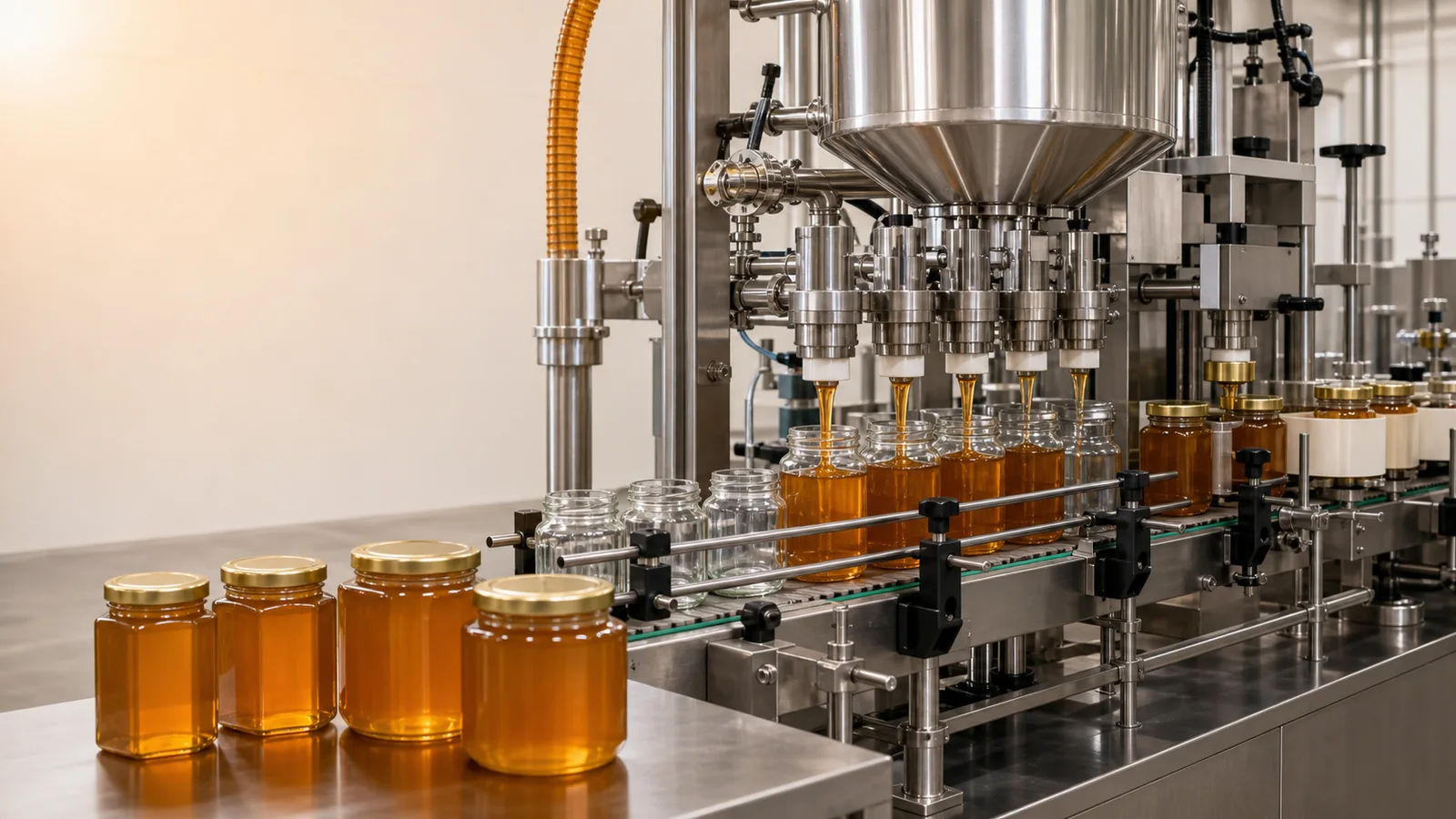
- Honey temperature and fluidity affect the choice of piston or other pump types. Screw capping for bottles, heat sealing for wide-mouth bottles, and sealing for pails are different downstream processes. Provide honey and container samples, filling temperature, fill volume, lid film structure, cleaning conditions, and target capacity.
Solution summary prepared for you
- For honey filling, first use samples at different production temperatures to confirm flow and stop cutoff performance, then use a servo piston liquid filling machine for quantitative trial filling.
- Heated hopper and jacketed pail are not fixed configurations for honey projects. Only when supply temperature needs to be controlled should they be connected to the material line, while also considering cleaning conditions.
- Screw cap bottles are handled by an automatic screw capping machine. For wide-mouth bottles with direct film on the mouth, use an in-line heat sealing machine for bottles to verify bottle-film fit.
Route comparison
- Suitable for projects that use actual honey samples to verify suction/discharge action and want to integrate fill volume control with bottle/pail conveying.
- The servo piston liquid filling machine can handle the honey quantitative process, making it easy to gradually adjust the filling action based on sample state.
- Before equipment determination, still verify honey fluidity at production temperature, fill volume, crystallization, and post-filling stringing.
- When representative honey cannot be provided or production state changes frequently, it is not advisable to skip trial filling and directly determine the material line and nozzle structure.
- First use a servo piston liquid filling machine for sample trial filling. If stringing is obvious, then combine with drip-proof anti-stringing filling nozzle components for verification.
- Suitable for production arrangements where supply temperature needs stable control and honey can meet filling and quality requirements at that temperature.
- Heated hopper and jacketed pail can be part of the material line to maintain the agreed supply state before material enters the filling station.
- Temperature control needs, material residence, cleaning conditions, and filling samples must be verified together. Do not decide heating based solely on 'high viscosity'.
- When samples can already supply stably under planned production conditions, or the process does not allow adding temperature, there is no need to configure a heated supply line.
- After confirming the need for temperature control, connect the heated hopper and jacketed pail to the servo piston filling station and recheck discharge performance.
- Suitable for bottle types that use screw caps to close after filling with honey, and where the cap and bottle mouth can be provided as a complete set for testing.
- The automatic screw capping machine independently completes cap tightening and can be connected with the upstream quantitative filling according to container cycle time.
- Bottle positioning, cap type, thread fit, and tightening method must be confirmed with samples from the same batch of caps.
- When containers use direct film sealing without screw caps, evaluate heat sealing film and should not arrange a screw capping station.
- Use an automatic screw capping machine for screw cap bottles. If there is also wide-mouth direct film sealing packaging, set up an in-line heat sealing machine for bottles separately.
Associated Equipment / Consumables
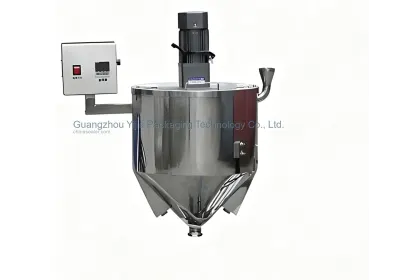 Heated Hopper and Jacketed Feed Tank
This is pre-filling storage and feed equipment, not a metering filler. Confirm target temperature, viscosity and particles, shear sensitivity, residence and settling, heating medium, level, outlet and return, contact...
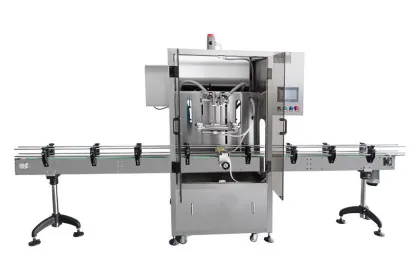 Servo Piston Liquid and Paste Filling Machine
First establish honey and packaging material samples; The same honey may change filling performance due to temperature. Record sample state during trial filling and avoid...
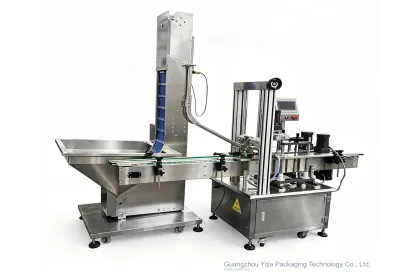 Automatic Screw Capping Machine
Match bottle screw capping station; Screw capping only applies to corresponding screw cap structures. Containers with direct film on the mouth should be transferred to the heat sealing...
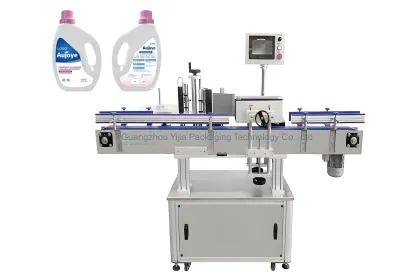 Round-Bottle and Front/Back Labelling Machine
Match bottle screw capping station; Screw capping only applies to corresponding screw cap structures. Containers with direct film on the mouth should be transferred to th...
Core process
Prepare honey at different production temperatures, planned bottles/pails, screw caps, and direct sealing film. First observe fluidity, stringing, and container rim condition.
The servo piston liquid filling machine handles quantitative filling. Use honey samples to observe suction, discharge, and stability after stopping.
When the production process indeed needs to maintain supply temperature, the heated hopper and jacketed pail can be connected to the material line. Projects that do not require temperature control do not need this step.
Bottled honey with screw caps is handled by an automatic screw capping machine. Bottle positioning, cap type, and tightening method must be verified with complete cap samples.
When wide-mouth bottles use direct film sealing, an in-line heat sealing machine for bottles can be used for trial sealing. Focus on rim continuity and film surface fit.
When obvious stringing is found during trial filling, select the drip-proof anti-stringing filling nozzle component, and verify the conveying state from container to screw capping or heat sealing station.
Sample details
This information is used to observe suction, discharge, and stringing after stopping, and to determine whether the supply temperature needs to be kept stable.
Provide actual honey samples, and state the temperature during filling, whether crystallized, whether visible particles are present, and the planned cleaning method.Container data affects positioning, filling nozzle entry position, and determines whether the downstream is screw capping or direct film heat sealing.
Submit physical containers of each specification or clear dimension drawings, indicating diameter, height, material, and the shape of the bottle or pail mouth.A complete bottle cap or film combination can be used to verify tightening, film placement, and rim fit. Do not provide only a single piece of consumable.
For screw cap projects, please send bottle caps together; for wide-mouth direct film sealing projects, please send both film material and corresponding containers.Fill volume and production mix affect the filling action and the cycle time coordination of downstream stations, and help determine whether a single machine needs continuous connection.
State the target fill volume for each packaging type, planned shifts, target capacity, and changeover between different specifications.On-site information is used to arrange heated supply, machine placement, and container flow. If information is temporarily missing, you can first submit floor plan photos and verify step by step.
Provide power supply, compressed air, available conveying space, existing heating facilities, and labeling or coding position requirements.Common selection mistakes
You should select the planned temperature conditions for trial filling and record stringing, dripping, and fill volume stability before determining the configuration.
First compare the fillability of samples under various production states. If temperature control is indeed needed, then discuss heated hoppers, jacketed pails, and cleaning integration.
During trial filling, observe both the filling nozzle cutoff and the container surface. If necessary, test the improvement effect of drip-proof anti-stringing components.
You should trial each container's actual cap/film structure separately. Just because both involve the bottle mouth does not mean they can be merged into the same sealing process.
Before quoting, you should clearly explain container diversion, labeling/coding positions, and the proportion of each packaging type, then verify the continuous production connection method.
View detailed technical notes
First Trial Fill with Honey in Production State
Honey fluidity changes with temperature. Trial filling should be done with the actual product, containers, and lid film as a complete set, then evaluate filling, temperature holding, and bottle mouth sealing separately.
Evaluate Filling, Screw Capping, and Film Sealing Separately
The servo piston liquid filling machine handles the dosing. Bottles with screw caps enter the automatic screw capping machine. Wide-mouth bottles where the film is placed directly on the mouth are trial-sealed by an inline heat sealing machine. These three serve different processes and cannot be summarized under one equipment name.
For Dosing Filling, First Check Suction and Nozzle Closure
Feed honey at different usage temperatures into the servo piston liquid filling machine and observe whether the feed is continuous, whether the fill volume is suitable, and whether there is trailing when the discharge stops. The trial fill results are used to determine the filling action and the combination of filling nozzles.
Add Heated Product Path Only When Needed
If the process requires a stable supply temperature, consider a heated hopper and jacketed tank. If honey can already be filled smoothly under the planned conditions, no additional temperature control should be added. Cleaning methods should also be considered together with the product path.
For Screw Caps, Trial Cap with Complete Bottle and Cap Set
The automatic screw capping machine needs to determine the positioning and tightening method based on the actual fit of the bottle body and cap. When sending samples, provide the bottle, cap, and the filled state together to avoid ignoring conveying changes after testing only empty bottles.
For Wide-Mouth Direct Film Sealing, Trial Heat Sealing Separately
The inline heat sealing machine for bottles is designed for structures where the film is placed directly on the bottle mouth. Trial sealing should check rim continuity, film surface adhesion, and post-seal appearance. Results from the screw cap route cannot be substituted.
Test Anti-Drip Components Only When Stringing Is Obvious
If honey forms long strings after leaving the filling nozzle or drips onto the bottle mouth, additional testing of anti-drip and anti-stringing filling nozzle components can be done. Whether to include this option is determined by sample performance, not installed uniformly for all honey.
Arrange Downstream Stations Separately for the Two Bottle Mouth Structures
When the project includes both screw cap bottles and wide-mouth film-sealed bottles, the packaging proportion, changeover method, and target cycle time should be counted separately, then arrange the screw capping and heat sealing stations to avoid interference between container flows.
Check Conveying and Marking Position Together
After the main process samples are stable, connect food-grade conveying lines, labeling machines for round or square bottles, or date/batch coding machines according to shipping requirements, and agree in advance on container orientation and marking position.
Common questions
I only have photos of the honey and bottles. Can we communicate first?
You can first describe the approximate state of the honey during production, the container type, and the planned fill volume. Based on this, we will distinguish between filling, screw capping, and direct film sealing directions, and then send key samples.
What physical samples are most needed before confirming the honey solution?
Please prepare honey at different usage temperatures, bottles or pails, screw caps or sealing film, and also provide fill volume, cleaning conditions, target capacity, and available on-site space.
Why can't you just provide one filling speed?
Honey fluidity, fill volume, and downstream screw capping or heat sealing methods all affect continuous operation cycle time. You should first run samples through each station, then verify the overall line coordination.
Does honey always need to be heated before filling?
Not necessarily. You should first trial fill with samples at the planned production temperature. Only when the supply temperature needs to be controlled should you consider a heated hopper and jacketed pail.
How to handle stringing and bottle mouth dripping?
First observe the actual honey's cutoff behavior when filling stops. If stringing is obvious, try configuring a drip-proof anti-stringing filling nozzle, and also check whether the bottle mouth remains clean.
Do I need to configure both a screw capping machine and a heat sealing machine?
It depends on the packaging structure. Screw cap bottles use a screw capping station; wide-mouth bottles with direct film sealing require evaluation of heat sealing. Only when a project has two types of containers should they be planned separately.